

Priced Out of Portland? Why a Condo or Townhome May Be the Smartest Way Into the Market in 2026
For many first-time buyers, the biggest obstacle to homeownership is not deciding whether they want to buy. It is figuring out how to make the numbers work.
Home prices remain elevated, mortgage rates continue to affect purchasing power, and the cost of a detached home in the Portland area can make buying feel out of reach. In June 2026, the median sale price across the Portland metro area was approximately $564,900. The region also had about 3.1 months of inventory, meaning buyers have more breathing room than they did during the most competitive years, but affordability remains a very real challenge. (Green Buck Real Estate)
That does not necessarily mean homeownership is off the table. It may simply mean looking beyond the traditional detached house.
For buyers who do not need a large yard, several extra bedrooms, or complete responsibility for every exterior repair, a condo or townhome can provide a more accessible path into the market. And in 2026, two national trends are making these homes especially worth considering: more inventory and a significantly lower median purchase price.
Condo and Townhome Inventory Has Reached a 10-Year High
One of the most encouraging changes for buyers is the number of attached homes now available.
In June 2026, there were approximately 233,030 condos and townhomes for sale nationwide. That was the highest June inventory level recorded in at least a decade and more than double the 101,415 units available in June 2022. (Century 21 Affiliated)
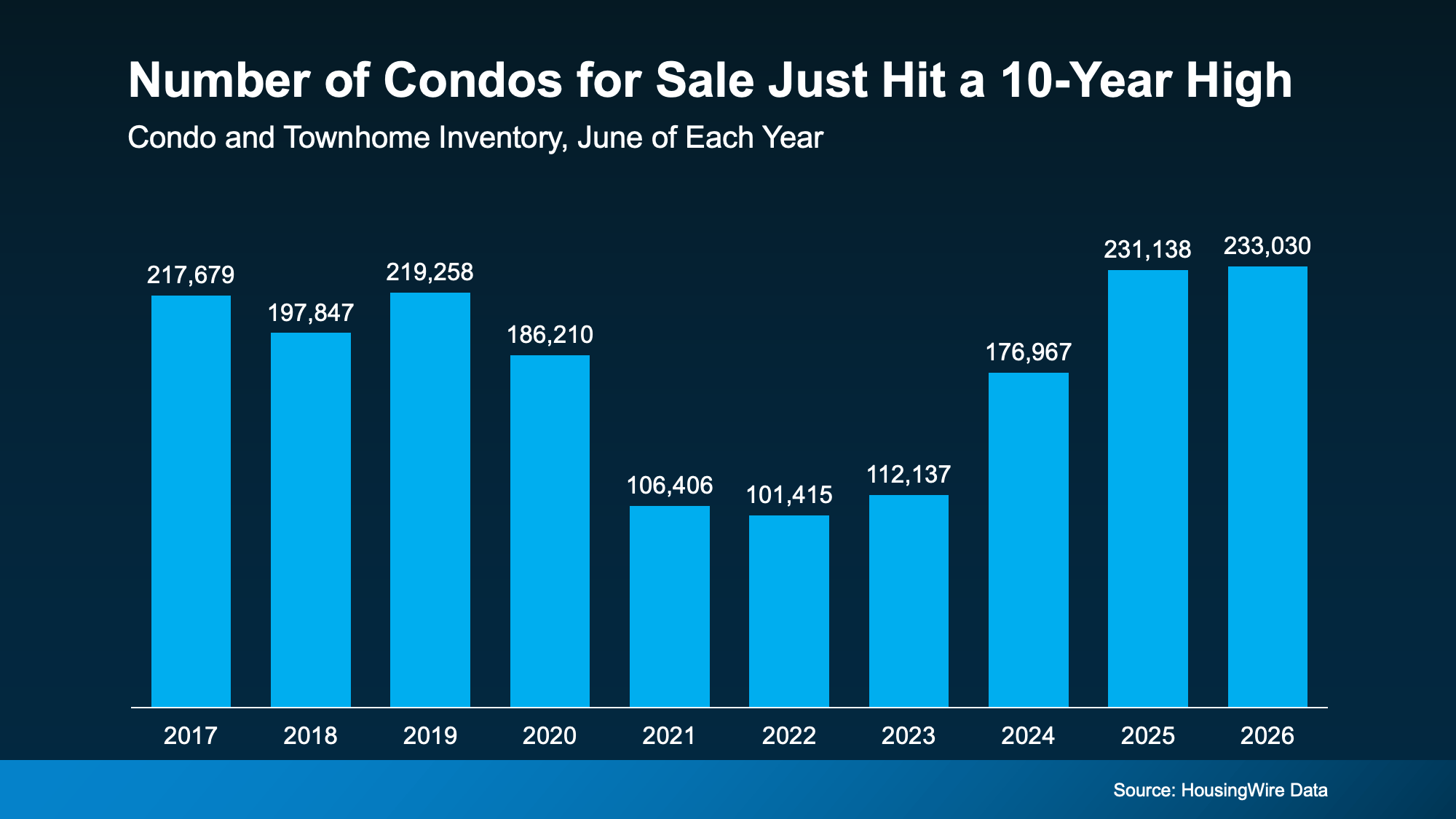
The graph tells an important story.
Condo and townhome inventory dropped sharply during the early pandemic years, reaching its lowest point in 2022. Since then, the number of available homes has climbed each year:
101,415 in June 2022
112,137 in June 2023
176,967 in June 2024
231,138 in June 2025
233,030 in June 2026
That represents an increase of nearly 130% from June 2022 to June 2026.
More inventory does not mean every condo market is oversupplied, nor does it mean every seller will accept a deeply discounted offer. Real estate remains highly local, and a well-priced home in a desirable Portland neighborhood can still attract strong interest.
But more available homes generally give buyers something they have not always had in recent years: options.
Instead of competing for the only acceptable property in their price range, buyers may be able to compare multiple buildings, floor plans, HOA structures, locations, and amenities. They may also have more time to review documents, investigate the association, obtain insurance information, and make a decision based on the complete picture rather than the pressure of a rapidly moving market.
This is especially valuable with condos because choosing the right home also means choosing the right community and homeowners association.
A Lower Entry Price Can Make a Meaningful Difference
Inventory is only part of the opportunity. The other major advantage is price.
According to the National Association of REALTORS®, the national median price of an existing condominium or co-op was $380,000 in June 2026. The median price of a single-family home was $446,400. That is a difference of $66,400, or approximately 15%. (NAR)
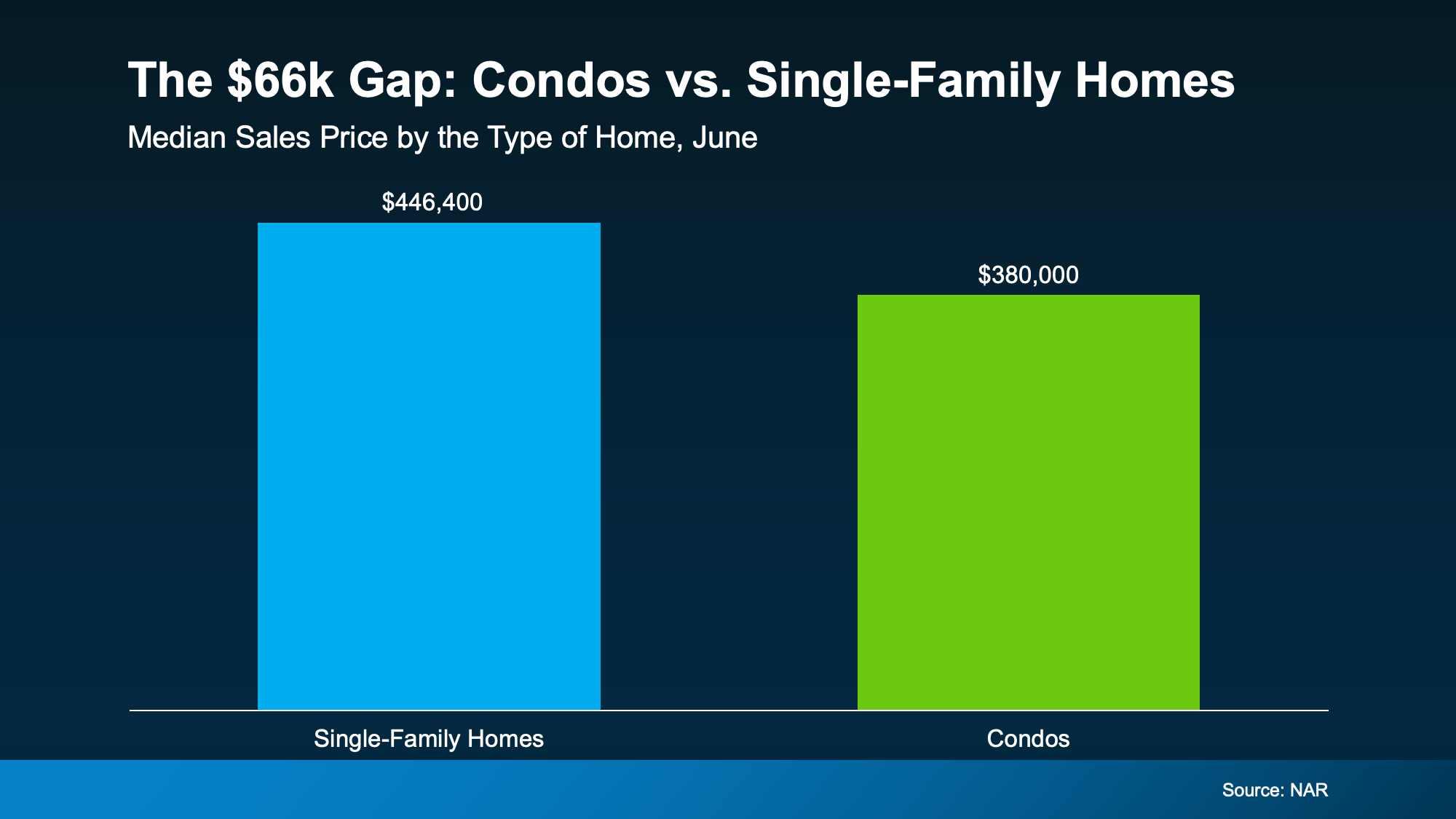
A $66,400 difference can materially change a buyer’s options.
A lower purchase price may mean:
A smaller down payment
A lower loan balance
A more manageable monthly principal-and-interest payment
Lower cash requirements at closing
The ability to keep more money in savings after the purchase
Access to a neighborhood that would otherwise be outside the budget
The comparison is not perfectly equal, of course. Condos are often smaller than detached homes, and monthly HOA dues must be included when evaluating affordability. But for someone who does not need a large property, paying for unused square footage and land may not be the best financial decision.
A smaller home in the right location can sometimes serve a buyer better than a larger home that creates financial strain or requires a long commute.
Why This Matters in Portland
Portland’s housing stock makes this conversation particularly relevant.
The city offers a wide range of attached-home options, from downtown high-rises and Pearl District lofts to courtyard condominiums, converted historic buildings, riverfront communities, newer rowhomes, and suburban-style townhomes.
A buyer who searches only for detached houses may unintentionally exclude hundreds of possibilities across Portland and the surrounding metro area.
Condos and townhomes can also provide access to neighborhoods where detached homes carry a much higher entry price. A buyer may be able to live closer to restaurants, parks, transit, employment centers, or neighborhood businesses by choosing an attached home rather than moving farther from the city to find a comparably priced house.
This is one reason we created Portland Condomania, a local resource dedicated specifically to Portland-area condos, lofts, and townhomes. Instead of treating attached homes as a small subsection of a general property search, the website allows buyers to explore them by neighborhood, city, region, building, and community.
Buyers can also browse individual Portland condo communities with active listings, photos, maps, and building information, making it easier to understand how one property compares with another before scheduling tours. (Condos in Portland OR)
Condos and Townhomes Are Not the Same Thing
The terms “condo” and “townhome” are often used interchangeably, but they can describe different things.
Most importantly, condominium is a legal form of ownership, while townhome usually describes an architectural style. A home can look like a traditional townhome but legally be organized as a condominium.
That distinction affects what you own, what the association maintains, what insurance you need, and which documents should be reviewed.
With a condominium
You generally own the interior of your individual unit along with a shared interest in the building’s common elements.
Depending on the community, the association may maintain items such as:
- The roof
- Exterior siding
- Hallways and elevators
- Landscaping
- Shared plumbing or mechanical systems
- Parking areas
- Community amenities
Your exact responsibilities will be defined in the condominium declaration, bylaws, maintenance provisions, and association rules.
With a fee-simple townhome
You may own the structure and the land beneath it, similar to a detached house, while sharing one or two walls with neighboring properties.
An HOA may still manage landscaping, private roads, common spaces, exterior appearance, or other community responsibilities. However, the individual owner may be responsible for more exterior maintenance than a typical condominium owner.
With a detached single-family home
You generally own the house and its lot and are responsible for nearly all maintenance, repairs, and improvements.
This arrangement offers more control and privacy, but it can also require more time and a larger reserve for repairs.
Because the legal structure varies, buyers should not rely on the property’s appearance or listing category alone. Your agent, lender, title company, and insurance professional should help confirm exactly what is being purchased.
The Purchase Price Is Only One Part of Affordability
A condo’s lower price does not automatically mean it will have the lowest monthly cost.
Most condominium communities and many townhome developments charge regular HOA dues. These payments are usually made directly to the homeowners association rather than included in the mortgage payment. Buyers should incorporate them into their monthly budget from the beginning. (Consumer Financial Protection Bureau)
HOA dues may cover expenses that a detached homeowner would otherwise pay separately, such as:
- Water, sewer, or garbage
- Landscaping
- Exterior maintenance
- Roof replacement
- Building insurance
- Management
- Security
- Common-area utilities
- Pools, gyms, or community rooms
A $500 monthly HOA fee may initially appear expensive. But the number has little meaning until you understand what it includes.
For example, one association may cover water, sewer, garbage, exterior maintenance, roof reserves, landscaping, and access to a fitness center. Another may charge a lower amount but leave owners responsible for more repairs and utilities.
The better question is not simply, “How high are the dues?” It is:
What do the dues cover, and is the association financially prepared for the property’s future needs?
What Buyers Should Investigate Before Purchasing a Condo
Buying a condominium requires another layer of due diligence beyond inspecting the individual unit.
You are not only evaluating the home. You are also evaluating the building, the association, and the financial health of the community.
Before completing a purchase, buyers should carefully review the available association documents and investigate several important areas.
1. The association’s financial reserves
Reserve funds are money set aside for major future expenses such as roofs, siding, elevators, plumbing systems, paving, windows, or structural repairs.
A building with low reserves is not necessarily a bad purchase, but buyers should understand how upcoming projects will be funded. An association without adequate savings may need to raise dues, borrow money, or charge owners a special assessment.
2. Pending or recently completed special assessments
A special assessment is an additional charge to owners, typically used for a major expense that cannot be fully covered by the operating budget or reserves.
Ask whether any assessments have been approved, proposed, discussed, or recently completed. Also confirm who is responsible for paying an existing assessment under the terms of the sale.
3. Meeting minutes
Board and association meeting minutes can reveal issues that are not obvious during a showing.
They may include discussions about:
- Roof leaks
- Water intrusion
- Insurance costs
- Noise complaints
- Elevator repairs
- Construction-defect claims
- Security concerns
- Planned assessments
- Delinquent owners
- Rental restrictions
- Major maintenance projects
The goal is not to find a building with no problems. Every property requires maintenance. The goal is to understand what the issues are and whether the association is addressing them responsibly.
4. Insurance coverage
Condo insurance is more complex than insurance for many detached homes because responsibility is divided between the association’s master policy and the owner’s individual policy.
Buyers should confirm what the master policy covers, what deductible applies, whether there are exclusions, and what type of individual unit-owner policy will be required. The Consumer Financial Protection Bureau specifically advises condo buyers to investigate insurance carefully because coverage responsibilities can be more complicated. (Consumer Financial Protection Bureau)
This step should happen early. Insurance availability and cost can affect both the buyer’s budget and the lender’s ability to approve the property.
5. Rental and occupancy restrictions
Some associations limit how many units can be rented, impose waiting periods before an owner may rent, restrict short-term rentals, or maintain a rental waitlist.
Even if you plan to occupy the property, these restrictions matter because your plans may change. They can also influence future resale and financing options.
6. Rules affecting everyday life
Review restrictions involving:
- Pets
- Parking
- Storage
- Smoking
- Flooring
- Noise
- Renovations
- Balconies and patios
- Electric vehicle charging
- Home-based businesses
- Move-in and move-out procedures
A condo can be financially sound but still be the wrong fit if its rules conflict with your lifestyle.
Financing a Condo Can Require Additional Review
A lender approving a condo purchase evaluates more than the borrower.
It may also review the condominium project itself, including its insurance, financial condition, owner-occupancy levels, commercial space, pending litigation, maintenance concerns, and other factors that could affect the property’s marketability.
This is often referred to as determining whether a project is “warrantable” or eligible under a particular loan program.
FHA financing can be used for units in approved condominium projects, and some units in non-approved communities may qualify through FHA’s Single-Unit Approval process. Eligibility still depends on the project satisfying specific requirements. (hud.gov)
The important takeaway is that buyers should involve a lender who understands condo financing before becoming emotionally attached to a property.
A strong condo-buying team should communicate early about:
- The buyer’s loan program
- Whether the project has been reviewed before
- The association’s insurance
- The percentage of commercial space
- Owner-occupancy requirements
- Litigation or deferred maintenance
- The documents the lender will need
A beautiful unit is not helpful if the building cannot qualify for the buyer’s financing.
Are HOA Fees “Throwing Money Away”?
Buyers sometimes view HOA dues as money that could otherwise be put toward a mortgage. That perspective leaves out an important part of the comparison.
Detached homeowners also pay for exterior maintenance, landscaping, insurance, roof replacement, siding, paving, drainage, and other property expenses. They simply pay for them individually and often irregularly.
With a condo, some of those costs are shared and collected over time through the association.
The real concern is not whether an HOA exists. It is whether the association is well-managed and whether the dues are appropriate for the services, insurance, maintenance obligations, and reserves they support.
Very low dues are not always an advantage. They may indicate that maintenance has been postponed or that the association is not adequately saving for future projects.
Conversely, higher dues are not automatically a warning sign. A building with elevators, secured parking, professional management, extensive common areas, or significant insurance obligations will naturally cost more to operate.
The numbers must be evaluated in context.
A Condo Can Be a First Step, Not a Final Destination
First-time buyers sometimes hesitate because they imagine their first purchase must satisfy every possible future need.
But a first home does not need to be a forever home.
A well-chosen condo or townhome can give buyers an opportunity to:
- Begin building equity
- Stabilize part of their housing cost
- Learn how homeownership works
- Establish a record of mortgage payments
- Live in a preferred location
- Build a financial foundation for a future move
There is no guarantee that a property will appreciate, and buyers should never purchase solely because they assume prices will rise. But ownership can still be a valuable long-term tool when the home fits the buyer’s budget, timeline, and lifestyle.
The smartest first purchase is not necessarily the largest home a lender will approve. It is the home that allows the buyer to own comfortably while continuing to save, handle repairs, and live the life they want.
Who May Be a Good Fit for a Condo or Townhome?
An attached home may make particular sense for buyers who:
- Want to stay closer to Portland’s urban neighborhoods
- Prefer walkability, transit access, or proximity to restaurants and shops
- Do not want to maintain a large yard
- Travel frequently
- Want a lower purchase price
- Value secured entry or community amenities
- Need fewer bedrooms than a typical detached home offers
- Prefer predictable shared maintenance costs
- Want to begin building equity without maximizing their budget
It may be less suitable for someone who wants complete control over exterior changes, needs substantial private outdoor space, plans to keep multiple large pets, or strongly dislikes association rules.
Neither option is universally better. The right choice depends on the buyer.
More Inventory Creates Opportunity, but Selection Still Matters
The record level of condo and townhome inventory is good news, but buyers should remain selective.
More choices can mean more negotiating leverage, yet it can also mean that some properties have been sitting for reasons that deserve investigation. A unit may be priced attractively because of high dues, a pending assessment, financing limitations, insurance challenges, deferred maintenance, or an inefficient floor plan.
That does not automatically make it a poor purchase. It simply means the buyer needs enough information to price the risk correctly.
A good condo search should compare more than countertops and bedroom counts. Buyers should evaluate:
- Total monthly cost
- Building condition
- Reserve strength
- Upcoming projects
- Insurance
- Financing eligibility
- Location within the community
- Parking and storage
- Noise exposure
- Resale appeal
- Association rules
- Long-term ownership plans
 Portland Condomania
This is where a specialized search resource can make the process much easier. On Portland Condomania, buyers can browse current listings and then explore options by Portland-area community, neighborhood, city, or property style. The site also includes dedicated searches for options such as Portland townhomes, high-rise buildings, new construction, lofts, and other categories. (Condos in Portland OR)
It is a useful starting point for understanding just how varied the Portland attached-home market really is.
Click to find your first condo>>
The Bottom Line
If detached homes have felt financially out of reach, it may be time to expand the search rather than abandon the goal.
Nationally, condo and townhome inventory has reached its highest June level in at least a decade. At the same time, the national median condo price remains more than $66,000 below the median price of a single-family home. Those numbers do not guarantee that every condo will be affordable, but they show why attached homes deserve a serious look in 2026.
A condo or townhome may offer a lower entry price, more choices, less exterior maintenance, and access to a location that would otherwise be difficult to afford.
The key is to evaluate the complete purchase: the unit, the monthly payment, the HOA, the building, the financing, and your long-term plans.
Start by exploring current condos, lofts, and townhomes on PortlandCondomania.com. When you find a few possibilities, the Hatch Homes Group can help you compare the true cost of ownership, review the association information, coordinate with your lender, and determine which property offers the strongest fit for your lifestyle and financial goals.
Because sometimes the way into the market is not spending more. It is searching smarter.