
Why Strategic Pricing Matters More Than Ever in Today’s Portland Real Estate Market
There is a moment in every home sale that quietly determines how the entire story will unfold.
It is not the photos.
It is not the staging.
It is not even the marketing plan.
It is the price.
In today’s shifting Portland and Southwest Washington real estate market, pricing correctly from day one is the single most important decision a seller will make. And unlike a paint color or a furniture choice, pricing is not easily adjusted without consequences.
At Hatch Homes, we believe every home has a story. But in this market, the first chapter buyers read is the price tag.
Let’s talk about why getting that number right matters so much right now.
The Market Has Shifted. Buyers Are More Analytical.
Over the past few years, sellers experienced historic demand, multiple offers, and price escalation. In many cases, the market forgave pricing mistakes.
That is no longer the environment we are in.
Inventory levels have risen compared to the ultra-tight pandemic years. Buyers have more options. Mortgage rates remain elevated compared to 2020–2021, which has made buyers more payment-sensitive. According to data from the National Association of Realtors (NAR), homes that are priced correctly at market value are significantly more likely to sell quickly and close near list price.
Today’s buyer is careful. They are comparing homes. They are watching price reductions. They are calculating monthly payments.
When a home is overpriced, buyers do not rush in. They scroll past.
The Most Common Pricing Mistake Sellers Make
When preparing to sell, many homeowners begin with an online home value estimate. It is understandable. It is easy. It is free. And it requires no conversation.
But here is the truth.
An algorithm has never walked through your home.
Online valuation tools rely on publicly available data and closed sales. They cannot see:
The custom built-ins you added last year
The quality of your renovation
The way natural light fills your living room at 4 p.m.
The fact that your street is quieter than the one two blocks over
The emotional appeal that makes buyers linger
Bankrate explains it well:
“While these tools can be a useful starting point, keep in mind that they typically do not provide the most accurate pricing. Algorithms can only rely on the information available; they can’t account for things like a home’s condition or renovations made since the last public information was updated.”
In a rapidly adjusting market, even a small pricing error can cost thousands. Price too high and you lose momentum. Price too low and you risk leaving money on the table.
Neither outcome is ideal.
Sellers Themselves Trust Local Agents Most
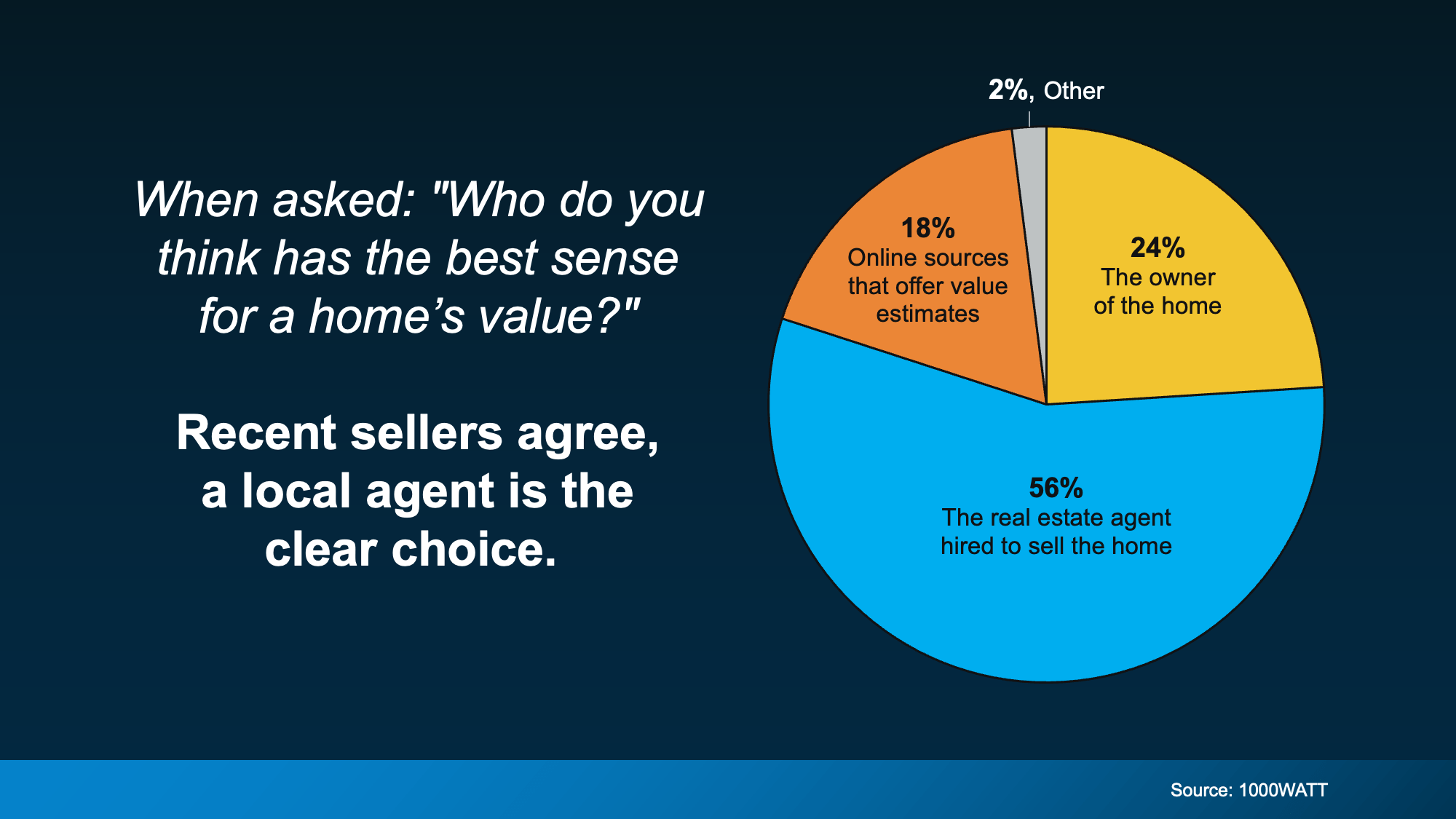
Recent data from 1000WATT shows something important. When asked who has the best sense of a home’s value:
56% said the real estate agent hired to sell the home
24% said the homeowner
18% said online sources
2% said other
That gap is significant.
It reflects something simple: real estate is hyper-local. It is nuanced. And it is dynamic.
A local expert does not just study data. They interpret it.
Why Pricing Right From the Start Matters
The first two weeks on market are critical.
When your home hits the MLS, it is pushed to thousands of buyers who have been waiting. It shows up in saved searches. It generates alerts. It creates curiosity.
That window is powerful.
If the price is aligned with the market, you create urgency. You invite strong showings. You may even create competition.
If the price is too high, buyers hesitate. Showings slow. Days on market increase. Eventually, a price reduction becomes necessary. And here is the difficult part: buyers notice.
A price reduction often signals one of two things to buyers:
The home was overpriced.
Something must be wrong.
Even if neither is true.
According to Realtor.com market data, homes that require price reductions typically take longer to sell and often close for less than those priced correctly from the start.
Pricing is not about optimism. It is about strategy.
What Strategic Pricing Actually Looks Like
Strategic pricing is not simply pulling the highest comparable sale in the neighborhood and adding five percent.
It involves:
1. Understanding Active Competition
Buyers are not choosing between your home and a sale from six months ago. They are choosing between your home and what is available right now.
2. Evaluating Pending Sales
Pending properties reveal what buyers are willing to pay in the current moment, even before those prices officially close.
3. Studying Price Per Square Foot Trends
This helps us understand how your home fits within the broader micro-market of your specific neighborhood.
4. Factoring in Condition and Presentation
A move-in-ready home will compete differently than one needing cosmetic updates.
5. Reading Buyer Behavior
Are open houses busy? Are buyers negotiating heavily? Are inspection requests increasing? These signals matter.
This is where local experience becomes invaluable.
Portland Sellers: What This Means for You
In the greater Portland metro and Vancouver market, we are seeing a more selective buyer pool. Homes that are updated, well-presented, and priced realistically are still selling. Homes that push beyond market tolerance are sitting.
This does not mean values are collapsing.
It means the market is normalizing.
And normalization requires precision.
If you are selling a home in neighborhoods like Sellwood, Cedar Mill, Sherwood, Tigard, Northwest Portland, or Vancouver, your pricing strategy must reflect what buyers in that micro-area are responding to right now, not what they paid in 2021.
That is a critical difference.
The Emotional Side of Pricing
There is something we rarely talk about openly.
Pricing is emotional.
Your home holds memories. Investments. Time. Sweat equity. It feels personal.
But buyers do not see your memories. They see comparisons.
The goal is not to discount your story. The goal is to position it correctly so the market validates it.
When pricing aligns with market reality, something powerful happens. Buyers step forward confidently. Negotiations are smoother. The process feels aligned instead of tense.
The story unfolds the way it was meant to.
How to Know If Your Home Is Priced Correctly
Ask yourself:
Are showings consistent in the first 10–14 days?
Are buyers giving positive feedback?
Are you seeing strong interest relative to competing homes?
Are offers coming in close to asking price?
If the answer is no, pricing may need to be reevaluated quickly before momentum fades.
In today’s market, early adjustments are strategic. Late adjustments are reactive.
The Bottom Line
Online tools can offer a starting point. They are convenient and sometimes directionally helpful.
But when it comes to selling one of your largest assets, directionally helpful is not enough.
The right price:
Protects your equity
Reduces time on market
Minimizes stressful negotiations
Maximizes your final net
In a shifting real estate market, pricing correctly from day one is not conservative. It is confident.
And the sellers who understand that are the ones who move forward smoothly, write their next chapter, and look back knowing they made the right call.
If you are considering selling in Portland, Vancouver, or the surrounding communities, take the time to understand the true story of your home’s value. Not just the number an algorithm gives you, but the number that reflects today’s market reality.
Because the right price does not just list your home.
It launches it.