
Why More Portland Homeowners Are Giving Up Their Low Mortgage Rate in 2025
For the past few years, Portland-area homeowners with 2–3% mortgage rates have been holding onto their homes longer than ever before. That ultra-low rate became a financial trophy — and for good reason. It saved hundreds per month and made homes purchased between 2020–2022 incredibly affordable.
But in 2025, something important is happening across the Portland-Vancouver metro area:
More homeowners are beginning to move, even if it means trading in that low rate.
New data from the Federal Housing Finance Agency (FHFA) shows that the number of sub-3% mortgages is declining, while the share of homeowners taking on 6%+ rates has reached a 10-year high. This shift is happening nationwide, but it’s especially noticeable in markets like Portland where lifestyle, job growth, and housing needs are rapidly evolving.
And it’s reshaping the local real estate landscape.
Understanding the Trend: Why Portland Homeowners Are Moving Even With Higher Rates
1. Portland’s housing needs are changing — and many homes bought during the pandemic no longer fit
In the pandemic boom, many buyers bought:
smaller starter homes in SE Portland or outer NE neighborhoods
townhomes in Hillsboro or Beaverton
condos in Northwest Portland for easy urban access
homes that worked during remote work but now feel cramped
Fast-forward to 2025, and Portlanders are facing new realities:
Returning to hybrid work and needing a better commute
Expanding families that need more bedrooms
Desire for larger yards or more privacy
Choosing to live closer to family in SW Portland, Happy Valley, or Vancouver
Downsizing into easier-to-maintain spaces as kids move out
A low rate simply cannot solve a lifestyle mismatch — especially in a city where neighborhoods offer very different lifestyles.
This explains why more Portland homeowners feel the need to move even if today’s rates are higher than what they currently have.
2. Portland's job market is pulling people into new neighborhoods
Greater Portland has seen shifts in where people work:
Tech growth along the Silicon Forest (Intel, Nike, Tektronix)
Increasing employment near South Waterfront
Suburban job corridors in Beaverton, Tigard, and Hillsboro
Vancouver and Camas seeing strong employer expansion
As job centers move, commute priorities follow.
Many homeowners who bought in 2020–2021 now have a completely different daily life. A long commute on I-5 or Highway 26 isn’t worth preserving a low rate for many residents — especially those balancing childcare, school drop-offs, or hybrid schedules.
3. Migration trends are reshaping demand in Portland
Portland continues to experience:
• Inbound migration from California, Seattle, and the East Coast
New buyers bring strong purchasing power — and they’re willing to take on today’s mortgage rates because they want to relocate now.
• Local movement from Multnomah County into Washington County and Clark County
Many long-time Portlanders are:
moving for more space
lowering property taxes
seeking newer construction
moving closer to schools or extended family
This churn in the marketplace means more homeowners are selling — even with a low rate — because life changes outweigh the cost of moving.
The FHFA Graph
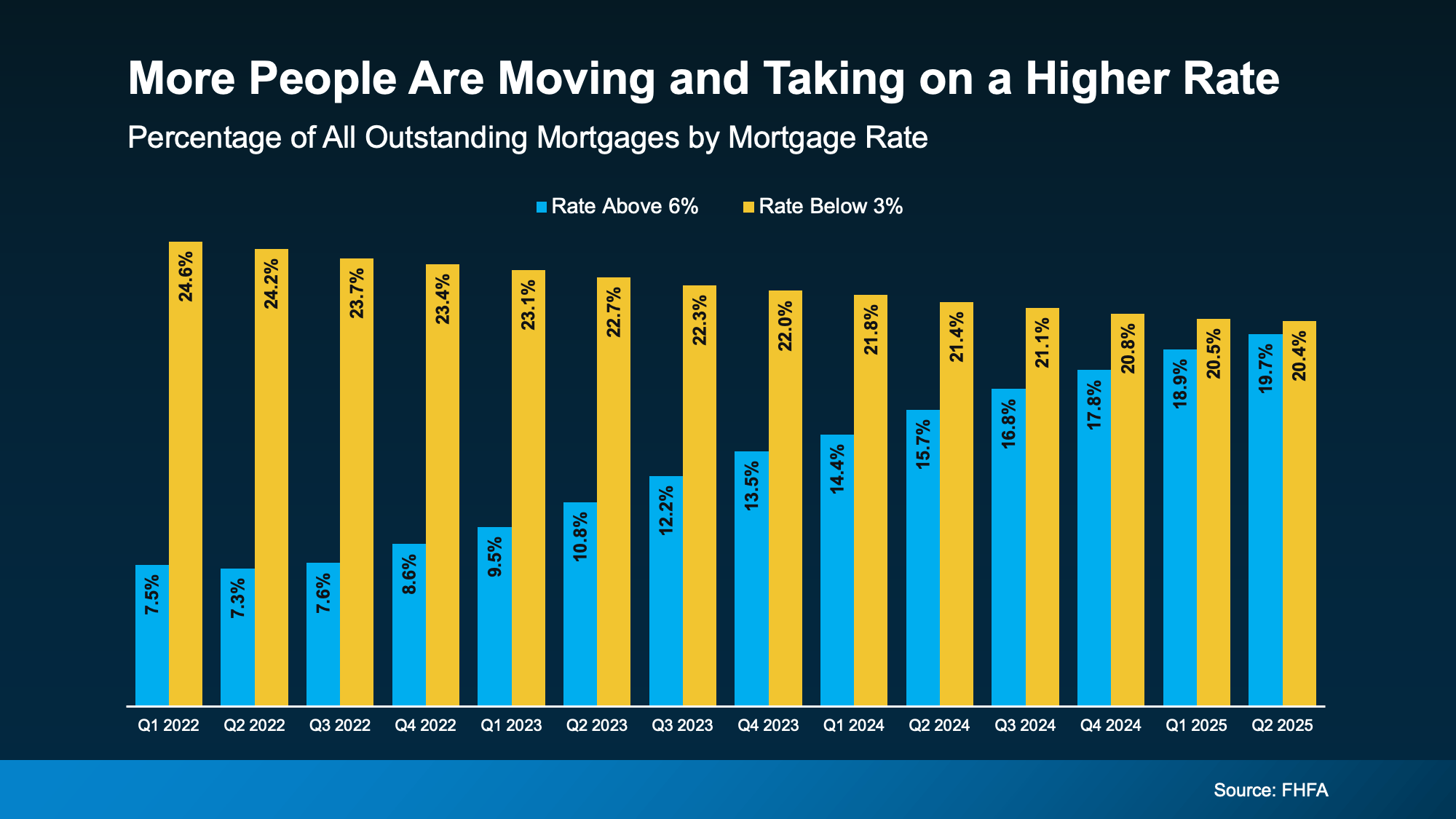
While this chart reflects U.S. data, it directly aligns with Portland market behavior:
Portland has one of the highest shares of sub-4% mortgages on the West Coast, so the lock-in effect hit our region harder.
Yet Portland also has one of the strongest lifestyle-driven relocation markets — people often buy here because of jobs, nature, schools, or walkability.
As a result, more Portland homeowners are crossing into 6%+ rates because they simply can’t delay life transitions any longer.
From 2022 to 2025, the share of mortgages above 6% has increased from around 7–8% to nearly 20%, reflecting a meaningful shift in seller behavior.
4. Portland’s home equity gains make moving more realistic
Homeowners across the city — from Sellwood to Cedar Mill to Alberta Arts — have seen significant appreciation since 2019.
According to FHFA, Oregon home values have risen roughly 40% in the past five years, depending on the neighborhood.
That equity can:
offset today’s higher rates
increase down payment strength
reduce monthly payments
give homeowners more choices in competitive neighborhoods
For many, equity is the tool that finally makes moving possible.
5. Portland inventory remains historically low — so sellers still have leverage
While higher rates have slowed some buyer activity, Portland inventory remains well below normal.
This is especially true in:
Inner Southeast (Hawthorne, Richmond, Woodstock)
Bethany / Cedar Mill
North Portland (Kenton, Arbor Lodge)
Vancouver East and Camas
Low inventory supports strong demand, which gives sellers more power than they might expect.
This is one reason many Portland homeowners are choosing to move now:
You may give up your low rate, but you gain strong selling conditions at the same time.
6. Rates have come down from their peak — and are expected to ease further
Portland buyers saw rates hit 7.5–8% between 2023–2024.
Today?
Rates are generally lower, and industry forecasts (Fannie Mae, MBA) expect gradual softening into 2026.
Buyers and sellers in the metro area are becoming more comfortable with the new normal, especially when the home they want offers the lifestyle they need.
What This Means for Portland-Area Homeowners in 2025
If your home no longer fits your life, you’re not alone. Homeowners throughout Portland, Vancouver, Beaverton, and Hillsboro are making the same decision:
Life needs come first — not interest rates.
People are choosing:
shorter commutes
better school districts
more space
less maintenance
proximity to family
more walkable neighborhoods
or simply a fresh start
And many realize that staying put for a rate is costing more in lifestyle value than it’s saving financially.
Bottom Line for Portland Homeowners
More homeowners across the Portland metro are choosing to move — not because they want to pay more, but because life has changed.
Rates have come down from their peak, equity is strong, and forecasted improvements in 2026 make the transition more manageable. If your home no longer fits your life or your future goals, now may be the time to explore what moving could make possible.